REVIEW · MILAN
Florence Renaissance and Medieval: Day Trip from Milano by High-Speed Train
Book on Viator →Operated by CAF Tour and Travel · Bookable on Viator
One easy train day makes Florence real. This day trip is built for you if you want Florence’s big sights without wrestling with tickets, routes, and timing on your own. I like the way the day mixes a focused guided walk with long stretches to wander, shop, and eat at your pace. You’ll also travel by high-speed train with reserved seats, which makes the whole plan feel calm instead of chaotic.
The two standouts for me are the short, story-driven walking route through the Medici and medieval core, and the visual hits you get fast—Duomo facade, Palazzo Vecchio, and Ponte Vecchio—all connected by streets that feel like an open-air lesson. There’s also the option to upgrade for Florence Duomo entry, so you can choose how deep you want to go.
One thing to consider: it’s still a walking day in a very popular city. If you dislike crowds or you’re not a fan of moving on cobblestones, expect to work your legs a bit before the free time even starts.
In This Review
- Key things to know before you go
- The Value Play: Why a Florence Day Trip From Milan Feels Easier
- 7:00 AM Departure and the Train Rhythm (What Your Day Actually Feels Like)
- The Guided Walking Route: Medici Power, the Duomo Facade, and Dante’s Streets
- Stop 1: Palazzo Medici Riccardi and the Medici neighborhood
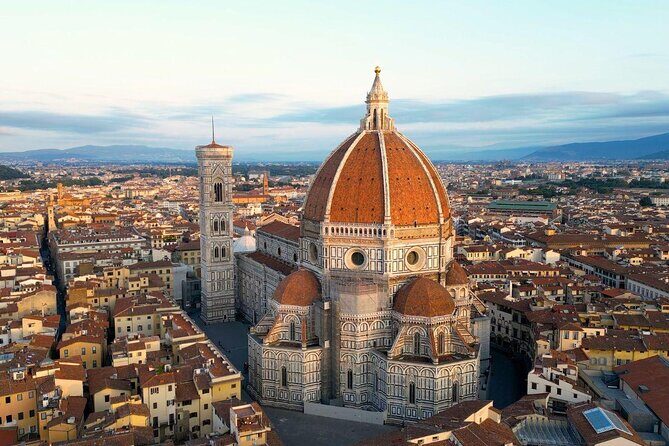
- Stop 2: Cathedral of Santa Maria del Fiore (Duomo complex) from close range
- Stop 3: Museo Casa di Dante and medieval Florence on foot
- Piazza della Signoria Through Ponte Vecchio: Art Outdoors, Power in Stone
- Stop 4: Piazza della Signoria and the Straw Market
- Stop 5: Palazzo Vecchio
- Stop 6: Ponte Vecchio and the Vasari Corridor viewpoint
- The 8-Hour Free Time: How to Spend It Like You Planned It
- Duomo Entry Upgrade: Worth It if You Want More Than a Facade Photo
- Crowds, Walking, and Realistic Expectations
- Who This Tour Fits Best (And Who Should Consider Another Plan)
- Should You Book This Milan-to-Florence Day Trip?
- FAQ
- How long is the Florence day trip?
- Where do I meet the group in Milan?
- What time does the tour start?
- Do I travel by train?
- Is the tour in English?
- How much time is there for free exploration in Florence?
- Is entry to the Florence Duomo included?
- How many stops are included in the guided walking portion?
- Are the sites included during the walk free to enter?
- Is there a refund if I cancel?
Key things to know before you go
- High-speed, reserved-seat train: Round trip from Milano Centrale to Florence Santa Maria Novella, with your seat held.
- A guided Renaissance and medieval walk: Led by local professionals, including guides like Marta, Yulia, and Mia (based on guest reports).
- Duomo upgrade is optional: Standard stops focus on key views, while Duomo entry is offered as an upgrade.
- Long free window in the center: You get about 8 hours on your own after the guided portion.
- Max group size is 25: Small enough that the guide can manage a real conversation.
- Punctual meeting matters: You must arrive on time to keep time-slot access from slipping away.
The Value Play: Why a Florence Day Trip From Milan Feels Easier
Milan to Florence by rail is one of those routes that’s made for day tripping. The schedule is simple: you leave in the morning, arrive with enough daylight to see the famous stuff, then you’re back in Milan the same day. What you’re really buying here is time—and stress control.
For $198.68 per person, the value isn’t just the train. You also get a local professional walking guide in Florence, plus help at the meeting points. The result is that you get orientation and context fast, which matters in Florence. Without that, you can wander for hours and still miss the connections between neighborhoods, power, art, and architecture.
If you want to sample Florence without committing to an overnight, this tour is a smart shortcut—especially if it’s your first time in the city.
You can also read our reviews of more tours and experiences in Milan
7:00 AM Departure and the Train Rhythm (What Your Day Actually Feels Like)
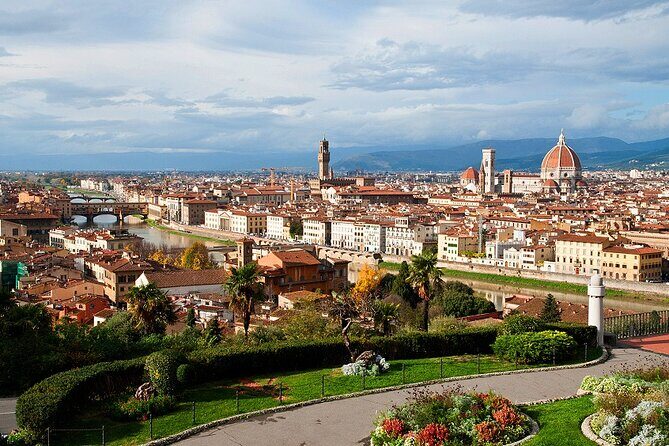
The day starts early, with departure at 7:00 am and a meeting point in Milan at Piazza Duca d’Aosta 1 near Milano Centrale. The key detail is not the morning alarm—it’s the rule that you need to be there early. You’re told to arrive at the station at least 20 minutes before departure, and the tour requires you to be at the Florence meeting check-in time too. If you miss that window, access may not be available and rescheduling isn’t guaranteed.
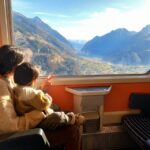
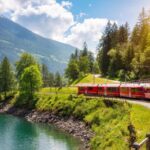
When it works, it feels smooth. You get a seat reservation on the high-speed train, and your ticket details are sent to you by email or WhatsApp the day before. In practice, that cuts down on the little anxiety moments: no last-minute ticket hunting, no guesswork about what platform to target.
You should also mentally plan for the “between the station and the guide” walking. Guests have described walking about half a mile to the starting point in Florence, plus additional walking during the guided portion. If you’re older, have a lower tolerance for long distances, or just don’t love cobblestones, put comfortable shoes at the top of your packing list.
The Guided Walking Route: Medici Power, the Duomo Facade, and Dante’s Streets
This is the backbone of the tour. The guided portion follows a logical loop through Florence’s Renaissance and medieval heart, with short stops—enough time to look closely, hear the story, and move on before the crowd pressure builds.
Stop 1: Palazzo Medici Riccardi and the Medici neighborhood
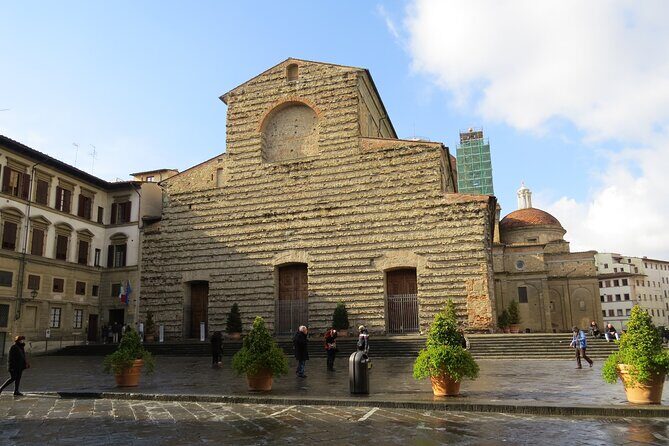
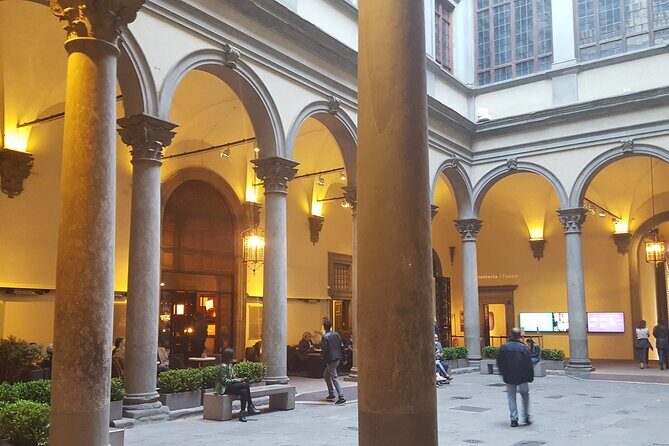
Your day begins at Palazzo Medici Riccardi, led by a local professional guide. This area matters because it sets the tone: Florence wasn’t just art and churches. It was politics and patronage, and the Medici family was at the center of it. You’ll see the famous Medici Palace, built in the mid-15th century, and learn why it mattered as the first residence of the powerful Medici clan.
From there, the route connects you to San Lorenzo Church and the Medici Chapels, including the mausoleum. Even if you’re not an architecture nut, this helps you understand why later masterpieces were commissioned and who benefited.
Stop 2: Cathedral of Santa Maria del Fiore (Duomo complex) from close range
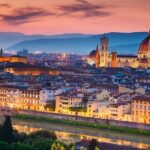
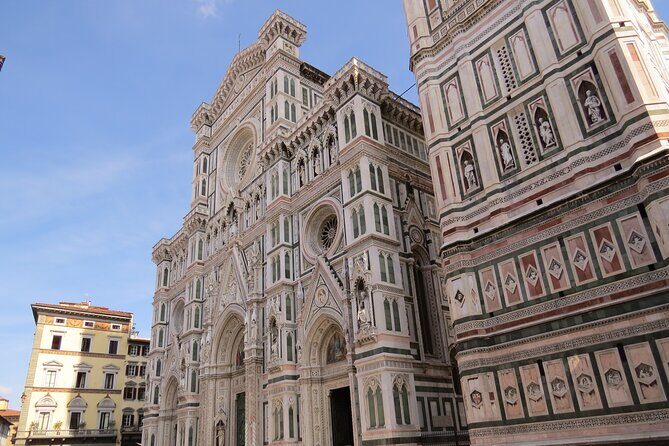
Next comes the Duomo complex. Even with minimal time, it’s hard to miss what makes it iconic: the monumental facade of Santa Maria del Fiore, Brunelleschi’s dome, Giotto’s Bell Tower, and the Romanesque Baptistery of San Giovanni.
One detail I’d watch for: the Baptistery’s golden Porta del Paradiso. You’ll hear references to it as a highlight, and it’s one of those “now I get why people hype this place” moments. The stop is short, though, so treat it as an orientation and wow-hit rather than a full deep visit.
Stop 3: Museo Casa di Dante and medieval Florence on foot
Then you step into the medieval district streets where Dante and Beatrice lived. This portion is a nice pacing change because you’re not just staring at big monuments; you’re moving through the kind of streets that shape the way the city feels.
You’ll also pass Orsanmichele, described as a masterpiece of Florentine Gothic art, with statues connected to patron saints of powerful medieval trading guilds. That guild angle is useful. It adds a social layer to what you’re seeing—Florence wasn’t only run by nobles and artists. Merchants and guilds had real influence too.
Possible drawback here: the tour is designed to move. If you want to read every panel, linger for photos, or go looking for side streets right away, the guided pace might feel a bit tight.
Piazza della Signoria Through Ponte Vecchio: Art Outdoors, Power in Stone
After Dante’s streets, you hit the big public spaces—the kind Florence does better than almost anywhere else.
Stop 4: Piazza della Signoria and the Straw Market
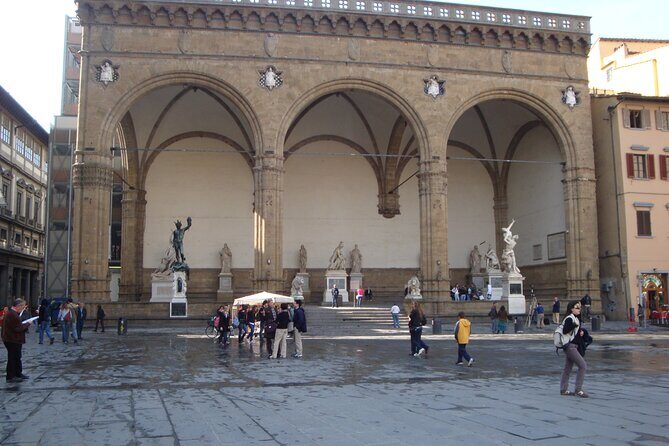
You’ll arrive at Piazza della Signoria, one of the city’s most important political squares. Before that, there’s a stop around the Straw Market, a quirky detail that adds character to the walk.
Then comes the must-do: rubbing the nose of the porcellino, the famous little pig statue. It’s a small tradition, but it’s exactly the kind of “I’m actually in Florence” moment that makes the city feel lived-in rather than staged.
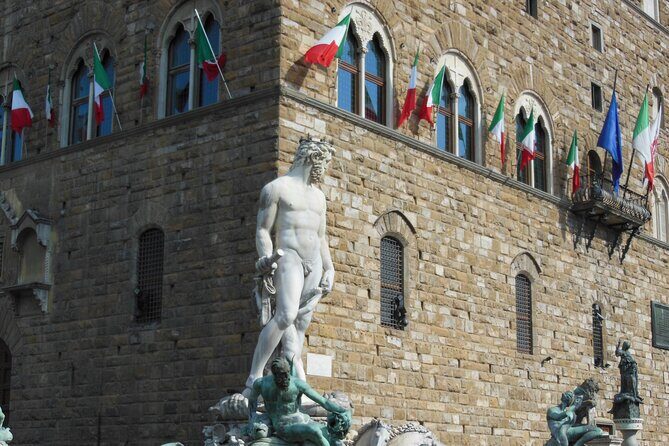
From there, you’ll see Fountain of Neptune and the Loggia dei Lanzi, with sculptural masterpieces called out during the walk. You’ll hear specific names like the Perseus by Cellini and the Rape of the Sabines by Giambologna. Even if you’re not memorizing sculpture history, it helps to know what you’re looking at instead of just seeing shapes.
Stop 5: Palazzo Vecchio
Dominating the square is Palazzo Vecchio, a major symbol of Florentine civic power. Expect to notice Arnolfo’s crenellated tower—another detail you’ll be glad the guide points out because it’s the kind of feature people pass without noticing unless someone tells you why it’s there.
Stop 6: Ponte Vecchio and the Vasari Corridor viewpoint
Finally you reach Ponte Vecchio, Florence’s oldest bridge. The guide will connect it to the Vasari Corridor through an elevated path viewpoint outside the corridor itself. The vibe here is romantic and photogenic, especially with the jewelry shops along the bridge.
You’ll end the walking tour here, with the sense that you’ve covered the “greatest hits” without turning it into a museum marathon.
The 8-Hour Free Time: How to Spend It Like You Planned It
Once the guided portion ends, you get about 8 hours at your own pace. This is where the tour pays off, because the guide gives you the mental map and the history shortcuts, then you decide where to go next.
A solid way to use the free time:
- Lunch at the Central Market area: One common suggestion is eating around Central Market. It’s a practical choice because you can refuel without crossing the city repeatedly.
- Shop for artisan goods: Look for local crafts and small shops. Florence is the kind of place where it’s easy to “just browse” and accidentally come home with something meaningful.
- Take a café break in Piazza della Repubblica: This is a classic stop to rest your legs and watch life go by.
One important reality check: even if the guided stops are short, you’ve already walked. If you want to explore more, pick one extra neighborhood to focus on instead of crisscrossing the city. A guest who traveled later in life noted that the walking stack can add up quickly; that’s a good warning to listen to.
Also, if you’re crowd-averse, time your strolls. Go for your shopping runs early in the free window, then shift to calmer, slower streets after.
Duomo Entry Upgrade: Worth It if You Want More Than a Facade Photo
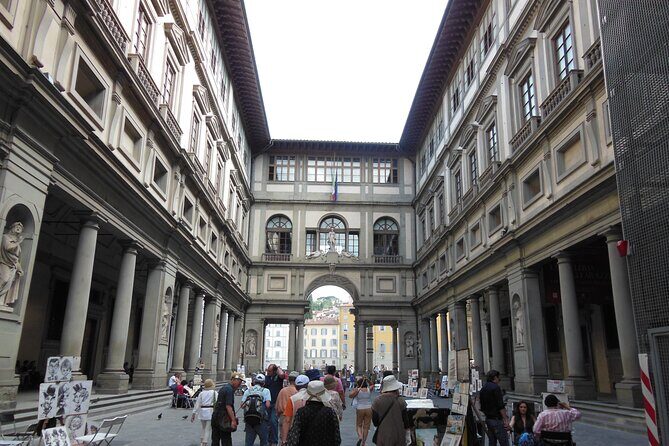
The tour includes time to see the Duomo complex highlights, but entry to the Duomo itself is offered as an upgrade. This matters because some people expect the iconic interior and end up disappointed if they only get exterior views.
The upside is that the base plan still delivers the key visuals in a way that fits a day trip. The downside is simple: if Duomo interior architecture and views are your top priority, check that you’ve added the Duomo entry option.
If you do upgrade, you’re turning the day into something closer to a full Florence architecture hit. If you don’t, you’re still seeing the parts that people remember—just not the inside.
Crowds, Walking, and Realistic Expectations
Florence is popular. You’ll feel it. The streets around the major sights get crowded, and that can slow your photo-taking and your movement.
Because the guided route is compact, the group tends to move as a unit. That’s good for staying on track and hearing stories. It can also make it harder to linger in the exact spot you want, especially when crowds press in.
If you’re traveling solo, this matters too. One reported problem was confusion about the Florence meeting spot when a train arrived late, and the person wasn’t able to catch up with the guide once the tour started. That’s a reminder to double-check your meeting point and keep your phone charged with offline maps if possible.
Who This Tour Fits Best (And Who Should Consider Another Plan)
This tour is a strong match if:
- You want a first taste of Florence without planning logistics.
- You enjoy history when it’s delivered through real places, not just facts.
- You like mixing a guided walk with hours to roam.
It may be a weaker match if:
- You dislike crowds and you want quiet, slow sightseeing.
- You want to see everything at a deep level. The time is tight, and you’re not doing a full-day museum sprint.
- You have mobility limits and long walking is a concern. The walking stack can be substantial for some people, even when each stop is brief.
If you’re on the fence, think of the tour as a high-quality sampler platter. You’ll likely want a second trip to go deeper.
Should You Book This Milan-to-Florence Day Trip?
Yes, if you want a guided, efficient first-day Florence that starts with a train ride you don’t have to plan. The combination of a reserved-seat high-speed train, a local professional walking guide, and a large chunk of free time is a very practical way to see the city’s biggest anchors.
Hold off or choose a different option if Duomo interior access is non-negotiable for you. Also consider whether you’re comfortable with a busy walking day in a crowded area, because the plan includes enough moving to test your shoes.
If your goal is simple—see the Renaissance and medieval highlights, then choose your own flavor for the rest of the day—this tour delivers that.
FAQ
How long is the Florence day trip?
It runs about 14 hours (approximately), with a guided walking portion and then free time for the rest of the day.
Where do I meet the group in Milan?
The meeting point in Milan is at Milano Centrale, Piazza Duca d’Aosta, 1, 20124 Milano MI, Italy.
What time does the tour start?
Start time is 7:00 am.
Do I travel by train?
Yes. You take a round trip high-speed train from Milano Centrale to Florence Santa Maria Novella, with seat reservation.
Is the tour in English?
Yes, the tour is offered in English.
How much time is there for free exploration in Florence?
You get about 8 hours of free time in Florence after the guided walking tour.
Is entry to the Florence Duomo included?
Duomo entry is not included by default. There is an upgrade option if you want to include Duomo entry.
How many stops are included in the guided walking portion?
The walk includes stops at Palazzo Medici Riccardi, Cathedral of Santa Maria del Fiore (Duomo complex), Museo Casa di Dante, Piazza della Signoria, Palazzo Vecchio, and Ponte Vecchio.
Are the sites included during the walk free to enter?
The tour info lists admission tickets as free for the listed stops during the guided portion, while Duomo entry is handled via an optional upgrade.
Is there a refund if I cancel?
Yes. Free cancellation is available up to 24 hours in advance of the experience start time for a full refund.