REVIEW · MILAN
From Milan: Discover Florence & Pisa on an Exciting Full-Day Tour
Book on Viator →Operated by Amigo Tours Spain · Bookable on Viator
Waking up early is the price of seeing more Italy. This full-day trip strings together Florence and Pisa with bilingual guidance and a scenic train ride that actually feels like part of the experience. You’ll get the big sights without having to plan every connection yourself.
I especially like the way the tour builds context as you move through the day: live commentary on the train (English and Spanish at the same time) plus a bilingual tour leader who stays with you in the cities. I also love the balance of “guided stops” and short “go at your own pace” time, so you can breathe, take photos, and slip into nearby streets.
The main drawback is that this is a tight itinerary with a lot of walking between sights. Add crowd levels in Florence and train delays that can happen on rail days, and you’ll want realistic expectations for a stress-free schedule.
In This Review
- Key highlights to know before you go
- A full-day Milan to Florence and Pisa run: what 15 hours really means
- Meeting at Terrazza Gallia and using the train time well
- Florence stop one: Piazza di Santa Croce and the names you’ll recognize
- Piazza del Duomo: the big square, the big views, and a solid hour to wander
- Ponte Vecchio: a short bridge walk with real merchant history
- A Dominican church stop: 15th-century frescoes in a quick, focused moment
- Piazza della Signoria and the power of the Old Palace
- Il Duomo (the cathedral complex): Brunelleschi’s dome and what to look for
- The Pisa switch: why Piazza dei Miracoli is the right way to see it
- Price and logistics: is $203.30 worth it for your day?
- Walking pace and comfort: who should love this tour
- Florence audio guide option: helpful, but only if you’re set up
- Shopping time that fits: how to use your free moments
- Should you book this Milan to Florence & Pisa tour?
- FAQ
- What time does the tour start in Milan?
- Where is the meeting point in Milan, and where do we end?
- How long is the tour?
- Is lunch included?
- Do I get an audio guide in Florence?
- Is this tour suitable for people with mobility problems?
- Is the tour refundable if I cancel or change my plans?
- Are baby car seats provided for young children?
Key highlights to know before you go
- Live English and Spanish commentary on the train keeps the day moving even while you’re seated
- Bilingual tour leader in the cities means your questions don’t get lost in translation
- Duomo area free time is your window for views, photos, and wandering into shopping streets
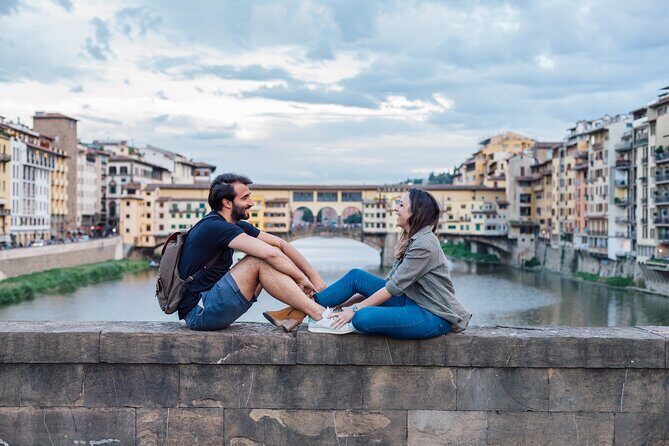
- Ponte Vecchio walk gives you a quick but memorable look at how merchants once lined the river
- Pisa in about an hour at Piazza dei Miracoli means big photos, quick cathedral sights, then back to the return plan
- Group size capped at 30 helps keep the pace more manageable than larger day tours
A full-day Milan to Florence and Pisa run: what 15 hours really means
This trip is built for speed. You start at 7:00 am in Milan, and the day stretches to roughly 15 hours including the travel between cities. It’s the kind of schedule where you’re “on” for most of the day, not drifting around at leisure.
That length matters because it changes how you should prepare. You’ll want comfortable walking shoes and a plan for hydration, snacks, and keeping your energy steady since lunch isn’t included. If you like a slow morning and long café breaks, you may feel rushed.
The flip side: if you’re short on time but want major landmarks from both cities, this tour gives you a structured route. You’re not trying to figure out transportation, entrances, and timing across two cities on your own. You’ll still get room to wander, but you’ll never be left wondering what comes next.
You can also read our reviews of more tours and experiences in Milan
Meeting at Terrazza Gallia and using the train time well
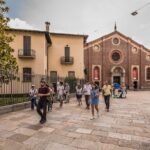
Your day starts at Terrazza Gallia, Piazza Duca d’Aosta, 9, 20124 Milano, and you end back at the same meeting point. The starting point being near public transportation is a practical bonus if you’re staying in the central area.
One smart feature is that you’re not just transported—you’re guided while traveling. There’s live commentary in the train, offered simultaneously in English and Spanish, so you can follow along even during the transit segments. That helps you understand what you’re about to see in Florence and Pisa instead of arriving cold.
Also note the tour’s flexibility: journeys between cities are by train, but if the group size doesn’t allow a quality service, the company may use bus instead. Either way, the day still follows a single flow with the tour leader coordinating where you need to be.
Mobile ticket? Yes. You’ll have a mobile ticket, which is usually easier than chasing paper vouchers. Just keep your phone charged so you’re ready when it’s time to present it.
Florence stop one: Piazza di Santa Croce and the names you’ll recognize
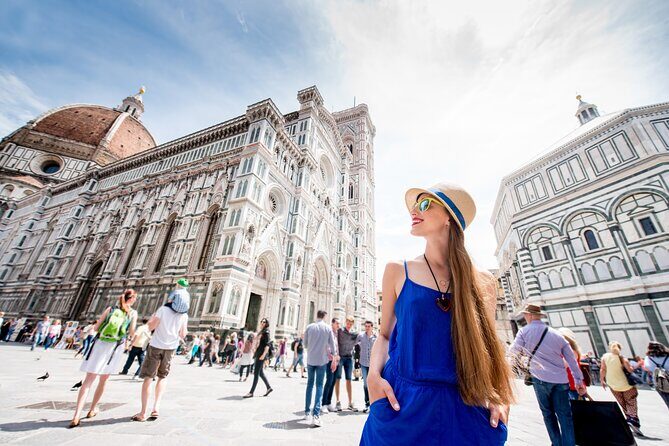
The first Florence anchor is Piazza di Santa Croce, centered on the Basilica di Santa Croce. This is one of Italy’s important Franciscan churches, known for its distinctive Gothic architecture. The tour also points out the fact that it’s a final resting place for major figures like Michelangelo, Galileo Galilei, Niccolò Machiavelli, and Dante Alighieri.
The value here is that you get instant context. Even if you don’t go deep into the chapels, you’ll feel the scale of who was connected to this place. And since the stop is listed as 10 minutes with admission noted as free, it’s clearly designed as a quick “get the mood and setting” start, not a long museum session.
Practical tip: because it’s short, arrive ready to look. Keep your phone away until you’ve glanced at the façade and the piazza edges. Then take pictures once you’ve got your bearings.
Piazza del Duomo: the big square, the big views, and a solid hour to wander
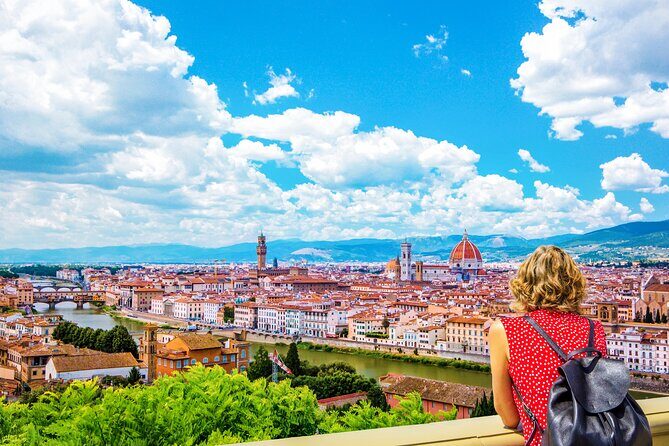
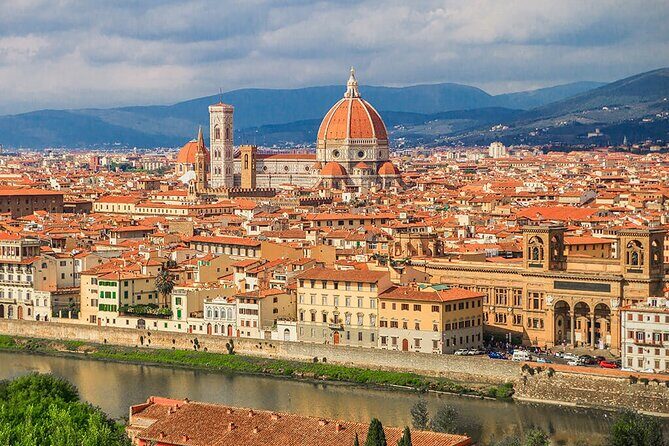
Next comes Piazza Del Duomo, the main square around Florence’s cathedral complex. Here you’ll see the famous setting for Santa Maria del Fiore and the area around Giotto’s Campanile. The tour includes free time (about 1 hour) for you to explore at your own pace.
This is one of the best parts of the day because it’s not only about a single photo point. You get time to walk the square, spot angles of the marble façade, and do the kind of wandering that day tours often cut. If you’re the type who wants to browse or just follow your curiosity down side streets, this is when you can do it.
One useful detail: a guide-and-time structure like this helps you avoid the worst problem with full-day tours—the “constant marching.” You still have a schedule, but your hour in the Duomo area lets you breathe and choose your own route around the square.
Ponte Vecchio: a short bridge walk with real merchant history
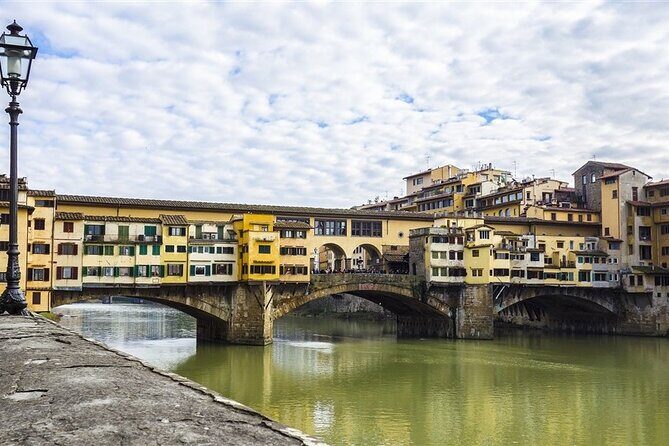
Then you’ll walk over the Vecchio Bridge and pass the shops lining both sides. The tour highlights that these were historically used by merchants—especially jewelers and goldsmiths. It also notes that the shop structure includes tents suspended over the river, supported by columns.
This stop works because it’s not just a scenic stretch. It shows you how Florence used space, commerce, and architecture together. The bridge is photographed constantly, but the “why it looks like this” makes the walk feel more grounded.
If your feet are getting tired, you can still do this well. Keep your pace easy, look left and right, and let the river views reset you before the next climb of the day’s schedule.
A Dominican church stop: 15th-century frescoes in a quick, focused moment
You’ll also have a stop for a spectacular 15th-century Dominican church with frescoes by Gothic and early Renaissance masters. Even though the description doesn’t name the building in your itinerary notes, the important takeaway is clear: you’re stepping into a church context that mixes key art periods.
This kind of stop is ideal on a packed day. You’re not trying to read a full art history syllabus. You’re getting a concentrated look at fresco style and the way the church world became a major art platform.
If you care about art details, use this stop strategically: don’t just take one quick photo. Look for the contrast between Gothic influence and early Renaissance work. Even a few minutes of careful looking can make it stick in your mind.
Piazza della Signoria and the power of the Old Palace
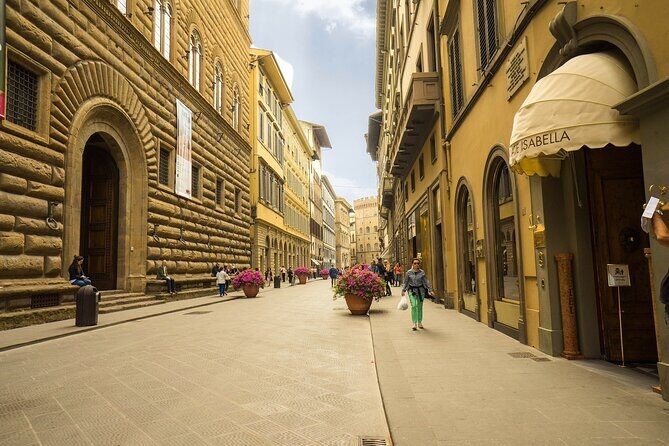
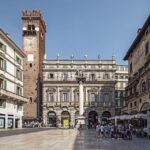
Next up is Piazza della Signoria, described as the seat of civil power, with the Old Palace and the heart of social life. This stop matters because it shifts you from church-centered Florence to civic Florence.
It’s a reminder that Florence wasn’t only cathedrals and domes. It was also politics, public life, and big civic identity—right here in the open square.
In a day like this, that change of scenery helps. You’ll likely feel “Florence overload” if you only chase religious landmarks. Piazza della Signoria adds variety and gives you that classic sense of the city as a lived-in place.
Il Duomo (the cathedral complex): Brunelleschi’s dome and what to look for
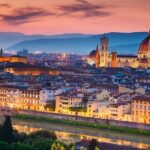
At some point you’ll connect back to the iconic “Il Duomo” area—Florence’s cathedral complex and its famous dome designed by Filippo Brunelleschi. The tour notes the red-tiled dome, the marble façade, and Giotto’s bell tower.
This part of the experience is less about a checklist and more about recognizing the design choices that made it famous. When you’re standing there, the dome stops being an image and becomes a form you can measure in your own space.
Because this tour is tight, treat this as your “look, locate, and understand” stop:
- Locate where the dome sits relative to the bell tower.
- Notice how the façade materials change the look as light shifts.
- Take one photo you’ll actually keep, not ten rushed ones.
The Pisa switch: why Piazza dei Miracoli is the right way to see it
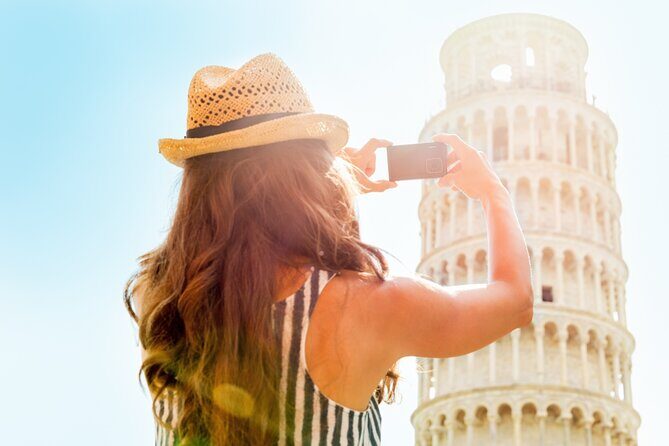
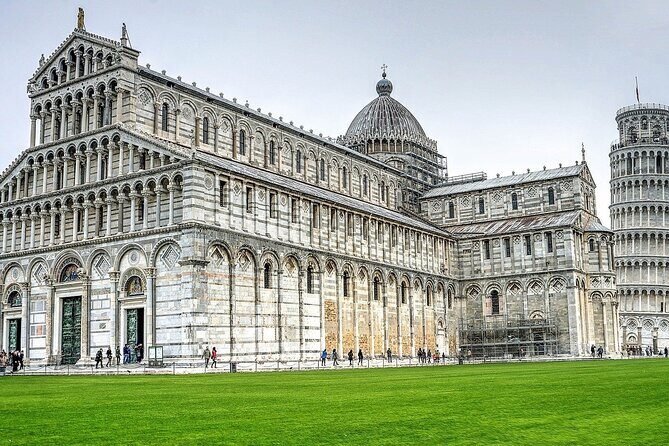
After Florence, the tour takes you to Pisa by train (with the same reality check: if there’s any disruption, you’ll be rerouted by whatever transport option is possible). In Pisa, you arrive at Piazza dei Miracoli, described as a square with green areas and the emblematic leaning tower, plus the majestic cathedral with marble bands.
You’ll have about 1 hour here, with free time for photos—especially “funny pictures” with the tower. This is the tour’s cleanest “time on your own” block.
One key expectation to set: Pisa on a tight schedule is mostly about this one monumental square. And that’s not a bad thing. You’re concentrating on the places that people travel for in the first place. The space also makes it easier to take photos quickly without needing complicated navigation through town.
The tour also includes attention to the Cathedral of Santa Maria Assunta at the center of Piazza dei Miracoli. It’s described as a medieval Catholic cathedral dedicated to the Assumption of the Virgin and the episcopal seat of the Italian city of Pisa.
Price and logistics: is $203.30 worth it for your day?
At $203.30 per person, you’re paying for organization: train travel from Milan, guided elements, and the bilingual commentary that helps you understand what you’re seeing.
This price makes sense when:
- You want Florence plus Pisa without planning train timing yourself.
- You value a guided structure more than wandering all day.
- You’ll use the free time blocks well (Duomo square and Piazza dei Miracoli).
It may feel steep if:
- You’re the type who wants long museum stays and slow lunches.
- You’re only interested in one city, because you’re paying for both.
- You’re anxious about schedule risk. Since this is train-based, delays can happen, and a strike or disruption can throw the day off.
I’ll be honest about the “what can go wrong” part: there have been accounts of trips being disrupted due to rail strikes, including situations where Pisa didn’t happen as planned and return travel took much longer. You can’t plan for labor unrest, but you can plan for your own flexibility—keep the rest of your itinerary light on that day.
Walking pace and comfort: who should love this tour
The tour itself warns about a very tight itinerary and that the distances in the cities are great. It also says travelers should have moderate physical fitness, and it doesn’t recommend the tour for people with mobility problems.
So who is a good match?
- You’re comfortable doing several blocks of walking with a firm schedule.
- You like big-picture sightseeing with short stops.
- You enjoy a guide talking while you move, not silent self-guided wandering.
Who might struggle?
- If you need frequent long rest breaks.
- If you have slower walking pace or mobility limitations.
- If you get stressed by tight meeting times and crowded squares.
Also, keep in mind Florence can be crowded around the main sights. Even with guidance, you’ll likely share the space with lots of other people. That doesn’t ruin the experience, but it changes the feel—more jostling, less “quiet contemplation.”
Florence audio guide option: helpful, but only if you’re set up
If you choose the Audio Guide in Florence, it’s an option rather than a baseline inclusion. Instructions to download it are sent after booking confirmation. You’ll need a smartphone with Android 5.0+ or iOS, and the audio tour isn’t compatible with some older Apple models and Windows phones listed in your tour notes.
You’ll also need internet connection to download the audio guide on the bus. And if you book the audio option, it’s recommended to bring headphones for a better experience.
For me, this audio option is best if:
- You like extra detail and don’t mind managing your phone while on the move.
- You want a second layer of context after the live guide commentary.
If you’d rather keep things simple, skip the audio and rely on the bilingual guide and your own looking time.
Shopping time that fits: how to use your free moments
One thing that comes up naturally on this style of tour: when you’re given an hour in the Duomo area, you can use it for more than sightseeing. People often wander into nearby shopping streets and find practical buys like leather goods, especially when you’re close to major pedestrian lanes.
I’d treat it like this: keep your “shopping mission” small and realistic. Pick one area to browse and set a time limit. Full-day tours reward people who don’t try to do everything in one free block.
Should you book this Milan to Florence & Pisa tour?
Book it if you want a guided, high-impact day that hits Florence’s key landmarks and then gives you a classic Pisa stop at Piazza dei Miracoli. The combo of train commentary, bilingual leadership, and short free-time windows is a smart way to make limited time count.
Skip or think twice if:
- You need a relaxed pace or longer sitting time.
- You’re sensitive to walking distances and crowding.
- Your travel plans are fragile and you can’t absorb the possibility of train delays or rerouting.
My bottom line: this is a good value if you’re time-poor and sight-focused, and you can handle a packed schedule. If you want a leisurely art day with zero stress, choose something slower.
FAQ
What time does the tour start in Milan?
The tour starts at 7:00 am.
Where is the meeting point in Milan, and where do we end?
You meet at Terrazza Gallia, Piazza Duca d’Aosta, 9, 20124 Milano, and the activity ends back at the same meeting point.
How long is the tour?
The duration is about 15 hours.
Is lunch included?
No. Lunch is not included.
Do I get an audio guide in Florence?
An audio guide in Florence is included only if you select that option. You’ll receive download instructions after confirmation, and you’ll need a compatible smartphone.
Is this tour suitable for people with mobility problems?
The tour has a very tight itinerary and great walking distances in the cities. It’s not recommended for people with mobility problems, and it requires moderate physical fitness.
Is the tour refundable if I cancel or change my plans?
The tour is non-refundable and cannot be changed. Train ticket purchases make it non-refundable in all cases.
Are baby car seats provided for young children?
No. Children under 11 must sit on a baby car seat, and the company cannot provide it, so you’ll need to bring your own.