REVIEW · MILAN
Private Tour from Milan: Venice Full Day Trip by Train
Book on Viator →Operated by Rental and Tour · Bookable on Viator
Venice, minus the travel stress, in one day. This private Venice full-day trip from Milan by train is built for people who want the headline sights plus the calmer corners, all with a guide steering the day. You start with a smooth rail ride, then walk Venice in a logical loop from canal views to churches, bridges, and back to the train.
I like two things a lot. First, you get Canal Grande and Rialto coverage early, when the city can still feel manageable. Second, the route includes some real Venice textures beyond the postcards, like the Squero di San Trovaso gondola shipyard area and the Banksy painting stop at Campo San Pantalon.
One drawback to plan for: the day is packed. With an early departure and many short stops, you can feel time pressure if you want long sits in every square, and Venice crowds plus lagoon air can affect photos and comfort at certain moments.
Key takeaways before you go
- Train rhythm that saves your energy: 2.5 hours in each direction, so you spend less time getting there and more time walking.
- Private guiding: only your group, with guides like Sneh, Elshad, and Dogan praised for pace and patience.
- Iconic + off-main stops: Rialto, St Mark’s, Bridge of Sighs, plus places like San Trovaso and San Zaccaria.
- Admissions listed as free for the stops: the plan marks each stop as ticket-free (you’re usually just following the guide and exploring).
- Flexibility is possible: at least some guides tailor the flow if you ask nicely and move with the group.
- Weather-ready: the tour runs in all weather conditions, so bring a backup layer.
In This Review
- A Milan-to-Venice Train Day That Feels Efficient (Without Feeling Like a Sprint)
- Price and Value: Is $391.34 a Fair Trade for One Day in Venice?
- Morning Setup in Milan: Milano Centrale at 7:30 and the 2.5-Hour Ride
- Canal Grande and St. Lucy: Your Best First Shot at Venice’s Famous Waterways
- San Giorgio dei Greci: The Leaning Clocktower That Tells a Bigger Story
- Strada Nova to Ponte di Rialto: Fast Walking Between Two Venice Power Centers
- Piazza San Marco and St Mark’s Basilica: The Main Stage, With a Guide’s Filter
- Bridge of Sighs: Doge’s Palace Meets the Prison Side of Venice
- San Zaccaria: A Big Church With a Courtyard-Feel Calm
- Ponte dell’Accademia and San Trovaso: Canal Crossings and Gondola Repair Reality
- Campo San Pantalon and Campo Santa Margherita: Art, Street Stories, and a Local Hangout Feel
- Piazzale Roma and the Trip Back: Ending Where Venice Meets the Roads
- How the Best Guides Make This Day Trip Feel Personal
- Should You Book This Private Venice Train Trip From Milan?
- FAQ
- How long is the Venice day trip from Milan?
- What time does the tour start?
- Is this tour private or shared with other people?
- What is included in the price?
- Are food and drinks included?
- When are train tickets purchased, and what if I cancel?
A Milan-to-Venice Train Day That Feels Efficient (Without Feeling Like a Sprint)
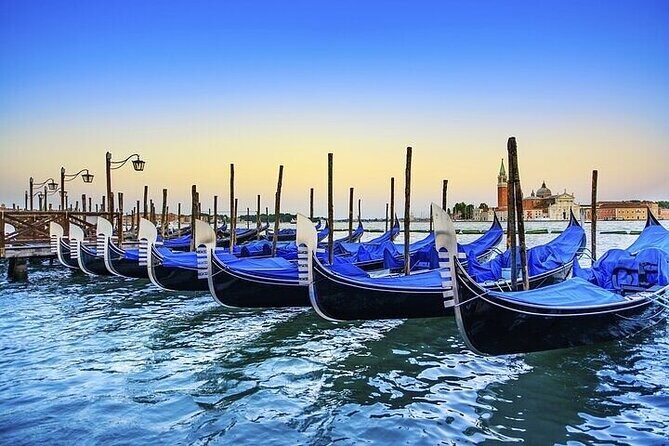
Venice is the kind of place that can eat your day fast—wrong turns, long lines, and the constant “wait, where are we?” moments. This tour solves a big part of that by handling the main travel piece with a round-trip 2nd-class train from Milan. After that, you’re in Venice with a private guide and a planned walking sequence.
The total time is about 11 hours, and it starts at 7:30 am from Milano Centrale (Piazza Duca d’Aosta, 1). That early start matters. You’re not just chasing the sights—you’re trying to beat the worst crowd crush where you can, then settle into the day when the city opens up.
Because it’s private, your guide can keep the pace sensible for your group. In guides praised by name—Sneh, Elshad, Mehmet, Dothan, and Dogan—you’ll see a pattern: clear explanations, careful attention to what you want to see, and help avoiding the obvious tourist traps. That’s not guaranteed for every minute of every day, but it’s a good sign of how the experience is designed.
Price and Value: Is $391.34 a Fair Trade for One Day in Venice?
Let’s talk value in plain terms. $391.34 per person is not a budget price for a day trip, but you’re paying for a few concrete things:
- A private guided day in Venice
- Round-trip train (2nd class)
- The Venice visitor fee
That means you’re not just buying a list of landmarks. You’re buying time savings and guidance so you don’t waste hours figuring out the geography and the “why” behind the sights.
Also, the schedule is made of short, ticket-free stops (each listed with admission ticket free). That matters because it keeps the day moving. If you’re the type who hates sitting in long museum lines just to see a plaque, this format may feel like a better match than a museum-heavy plan.
Where price can feel harder is if you want a slow day—one that includes long meals, long gondola rides, and lingering in every chapel. This tour can still make room for breaks, but you’ll want to be ready to accept that your time in Venice is intentionally structured.
You can also read our reviews of more private tours in Milan
Morning Setup in Milan: Milano Centrale at 7:30 and the 2.5-Hour Ride
The meeting point is Milano Centrale, Piazza Duca d’Aosta, 1. The start time is 7:30 am, and the train segment to Venice is about 2.5 hours. You’ll also get your train info ahead of time via email and WhatsApp, and the tickets are handled for you.
Here’s why I think this matters: early in a trip, logistics can kill your mood. When someone else manages the train tickets and day-of details, you can focus on the experience instead of spreadsheets.
The tour uses mobile ticketing, and it’s described as near public transportation, which is reassuring if you’re not staying right next door to Milano Centrale. If your group is coming in from elsewhere in Milan, plan to arrive a little early so you’re not rushing through the station at departure time.
One practical note: the train ticket is purchased 48 hours in advance, so it’s wise to treat your travel dates as fixed once you book.
Canal Grande and St. Lucy: Your Best First Shot at Venice’s Famous Waterways
The day kicks off in Venice with Canal Grande, and you get about 3 hours here, which is longer than any other listed stop. The Grand Canal is the city’s main watery spine—about 4 kilometers long—and it’s lined with buildings in a Venetian-Gothic style that can look almost stage-set when the light is right.
This is the moment to get your bearings. The city’s canals behave like streets, so seeing the canal first helps you understand why the rest of the day makes sense. You get the big visual reference point: the Grand Canal divides Venice, with the “cross-city” feeling you’ll notice all day as you hop from bridge to bridge.
You’ll also have a chance to see the Sanctuary of St. Lucy during this segment. That’s a nice pairing: big iconic water view energy, then a slower, more local-sounding religious stop to break the intensity of sightseeing photos.
If you’re picky about photo conditions, keep in mind that Venice air and water smell are real. You may not love it at every canal moment, but if you’re outside during calmer stretches and you keep moving, it tends to be manageable.
San Giorgio dei Greci: The Leaning Clocktower That Tells a Bigger Story
Next is Chiesa di San Giorgio dei Greci, where the most eye-catching feature is the campanile—a leaning bell tower often described as the leaning clocktower. It was designed by Simone Sorella and completed in 1592, and the tower is said to have started tilting from the beginning of construction.
This stop is only 30 minutes, but it’s a strong reminder that Venice wasn’t just one culture. The bell tower and adjoining church were built by and for Venice’s Greek community, including sailors and merchants. So while you’re looking at a weirdly human-looking tower (gravity doing its thing), you’re also learning how different groups shaped Venice’s neighborhoods and trade.
Practical tip: this is a good stop for “quick wonder.” You don’t need to settle into a long visit to get the meaning. Just get your angle on the tower, listen to your guide’s story, and move on.
Strada Nova to Ponte di Rialto: Fast Walking Between Two Venice Power Centers
After that, you’ll pass through Strada Nova, described as Venice’s widest street. It may not feel like much from far away, but the point of Strada Nova is huge: it was created in the 19th century to give pedestrians faster access between Rialto and the railway station. To do it, buildings that would have forced you through a longer chain of narrow streets were demolished.
This is one of those “why the city looks the way it does” stops. Venice is famous for narrow lanes; Strada Nova exists because someone decided, in modern times, that people needed a shortcut.
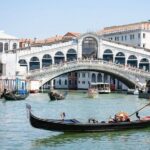
Then you hit Ponte di Rialto, the oldest of the four bridges spanning the Grand Canal. It’s famous for its architecture and history, and it was for years the hub of Venice’s economy.
What I like about this segment is the flow. You go from a street made for pedestrian movement to a bridge that once powered trade. Even if you only spend 30 minutes at Rialto, you walk away with the feeling of what mattered there.
You can also read our reviews of more tours and experiences in Milan
Piazza San Marco and St Mark’s Basilica: The Main Stage, With a Guide’s Filter
At 30 minutes, your time in Piazza San Marco is short, but it’s the right kind of short. St Mark’s Square is the principal public square in Venice, and it’s so famous that Napoleon Bonaparte called it the most beautiful hall in Europe.
You’ll be near St Mark’s Basilica, with its interiors covered in gold-ground mosaics depicting saints, prophets, and biblical scenes. Even a quick look (plus a good explanation) can help you understand why the square is treated like a living symbol of Venice.
Here’s how to make this kind of stop feel worth it: treat it as an orientation moment, not a full museum day. Get the layout in your head—square first, basilica context second—then use your guide’s cues to pick what to notice quickly.
Bridge of Sighs: Doge’s Palace Meets the Prison Side of Venice
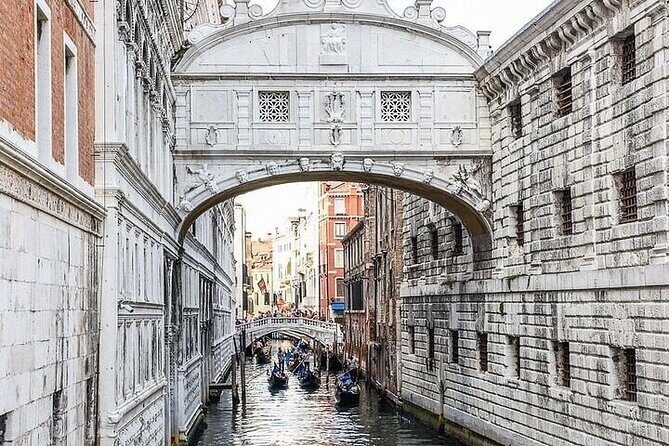
The Ponte dei Sospiri is one of the most “bookable-in-a-day” stories Venice has. It’s called the Bridge of Sighs (in local tradition), and it connects the Doge’s Palace to the historic prison on the other side of the canal. Built in the 1600s, it got its nickname from the idea that prisoners crossing it sighed at the prospect of seeing the outside world for the last time.
This stop is 30 minutes, and that’s enough. The key is to understand the symbolism without treating it like a scary horror attraction. The guide’s context turns a pretty bridge into a window on how power and punishment worked in historic Venice.
If you care about photos: plan for the canal-side perspective and keep your camera ready, but also accept that crowded angles happen.
San Zaccaria: A Big Church With a Courtyard-Feel Calm
Now you shift to Chiesa di San Zaccaria, a former monastic church in central Venice. The present church was built between 1458 and 1515, with a facade that blends late-Gothic and Renaissance styles.
It’s located in Campo San Zaccaria, and the atmosphere there can feel like the square acts as a little pause button. Instead of jumping straight from bridge to bridge, this is one of the stops where you can slow down and let the architecture land.
This is another 30-minute segment, so don’t expect a deep, hour-plus church tour. But with a guide explaining the building’s timeline and style, you’ll likely come away with a clear sense of why it looks the way it does.
Ponte dell’Accademia and San Trovaso: Canal Crossings and Gondola Repair Reality
Next comes Ponte dell’Accademia, one of only four bridges spanning the Grand Canal. It crosses near the southern end of the canal and is named for the Accademia di Belle Arti di Venezia.
This bridge works as a “reset” point. You get another major crossing view without the intensity of Rialto crowds, and it helps the day stay visually connected instead of feeling like a random list of stops.
Then it’s off to Squero di San Trovaso, described as one of the oldest and most famous squeros—the classic Venetian shipyard where smaller boats like gondolas are repaired. You can have a peek at how a gondola is made or repaired during your visit.
I love this stop because it gives you the Venice beyond the perfect architecture. You’re seeing a craft process tied to the city’s identity. Even if you’re not a boating person, the idea that gondolas are still repaired there brings the whole day into focus.
Campo San Pantalon and Campo Santa Margherita: Art, Street Stories, and a Local Hangout Feel
At Campo San Pantalon, you’ll have a chance to admire a painting by Banksy, commonly referred to as the shipwrecked/migrant child. This is a small stop, just 30 minutes, but it’s exactly the kind of modern counterpoint that makes Venice feel less like a frozen museum and more like a living city.
Then you move to Campo Santa Margherita, located in the sestiere of Dorsoduro near university buildings. It serves as a gathering place for students at the end of the day.
Even with only 30 minutes, this is a good place to recharge your legs and watch the city do its normal thing. It’s also a helpful pause before you reach the departure area.
Piazzale Roma and the Trip Back: Ending Where Venice Meets the Roads
Your final stop is Piazzale Roma, the square at the entrance of Venice at the end of the Ponte della Libertà. It’s one of the only spots within Venice’s insular urban core where ground motor vehicles can reach, along with nearby Tronchetto island.
This is a practical way to end the day. You’re not scrambling for your meeting point. You’re walking toward the train zone like you planned it, because you did.
Then you take the train back to Milan, about 2.5 hours.
How the Best Guides Make This Day Trip Feel Personal
A private tour can go two ways: either it’s just the same route, but with fewer people. Or it becomes more flexible and thoughtful. The experiences linked to guides like Sneh and Elshad suggest the second approach is often the result.
Here are signs to look for:
- Guides who explain the why behind each place, not just the dates
- Guides who help you avoid the obvious tourist traps
- Guides who can tweak timing if you have a specific interest, like stopping for a local craft shop or adjusting the flow as you go
One practical lesson from the guide feedback: if you want something extra—like a reputable local shop stop—ask early and keep it realistic. The tour includes lots of short segments, so the earlier you communicate your priorities, the more likely the day can stay smooth.
Should You Book This Private Venice Train Trip From Milan?
Book it if you want:
- A structured, time-efficient Venice day that uses the train smartly
- A private guide who can interpret the sights and keep the pace comfortable
- A route that mixes big landmarks (Canal Grande, Rialto, St Mark’s) with craft and everyday-city stops (San Trovaso, Campo Santa Margherita)
Skip it (or consider a different format) if you strongly prefer:
- A slow, unstructured Venice wander where you don’t feel any schedule pressure
- Long church or museum visits that need more than a quick guided context
- A day where you can ignore crowds completely. Even with smart routing, Venice is Venice.
My take: for first-timers—or anyone who wants a clear, guided day without wrestling transport—this is a solid choice. Just go in knowing it’s a full itinerary with lots of movement, and you’ll get the most out of it.
FAQ
How long is the Venice day trip from Milan?
It lasts about 11 hours total. The train ride to Venice is about 2.5 hours, and the return train ride is also about 2.5 hours.
What time does the tour start?
The tour starts at 7:30 am, meeting at Milano Centrale (Piazza Duca d’Aosta, 1, 20124 Milano MI, Italy).
Is this tour private or shared with other people?
It is private. Only your group participates.
What is included in the price?
Included items are the private guided tour, transport by train (2nd class), and the Venice visitor fee.
Are food and drinks included?
No. Food and drink are not included.
When are train tickets purchased, and what if I cancel?
Train tickets are purchased 48 hours in advance. Cancellation is free up to 24 hours in advance for a full refund, and the tour notes that the train ticket costs are fully charged if cancellation happens up to 48 hours prior to departure.